Showing posts with label diagnosis. Show all posts

Wednesday, November 25, 2015

What chronic illness & disability has taught me....

Inspirationboost.com
I know many people dislike the use of the word 'journey', I was also one of those people. It is often mocked, quite cliché, overused, deep and can be seen as slightly spiritual. Another part of me believes it is also important to give yourself credit for the continuous growth within any difficult, overwhelming circumstances that life may potentially throw at you. Chronic illness and disability have personally been a great example of what that word means to me. It is how I find my personal hope in something I didn't expect to occur in my life. However small that hope may seem in the grand scheme of things, it is something that I am constantly learning from.

Life really is so uncertain, sadly it usually takes unpleasant situations in life for us to truly realise how apparent this statement is. How precious health, happiness and movement within our bodies can truly be. Nobody is invincible in how life may change or evolve unexpectedly. You can't predict an illness, a disability or any unexpected event of any sort. You can only try to fathom why you have found yourself in this position. If your answer like mine, seems to be that of a specification that feels out of your hands, such as an incurable illness, then you can only try to make the best of that situation. Which I'm sure is something we all try to do, day in day out.  

Incurable illness and disability are not easy traits to be designated in life. Some people who live in similar circumstances make it look easy. Their strength can make the most content of us question our own existence within our troubles, our limits, our attitudes and our strengths. In reality, no day is easy in the slightest when you live this way. A brave face can go an incredibly long way, it does not always confirm an individuals resilience in bouncing back quickly from personal difficulties. Being chronically ill and because of this, currently disabled from a rare illness, has categorically been the most difficult, unsettling and saddest time of my life. Yet I know realistically, nothing can unnerve me as much as this process has. Nothing could feel as difficult as this process has felt over the last nine years. On the spectrum, it may not seem as difficult to what life has thrown at someone else, yet it doesn't matter because as an individual, it was difficult on a personal level none the less. I can now take that thought with me throughout my life, remembering it in every obstacle and barrier. 

Strangely, I have never wanted nor expect to be cured. I accepted that part of the package a long time ago.  A lot of people who are chronically ill or disabled will want to be cured and there is nothing wrong with that, I hope they can all individually reach that place. My focus has always been hoping that one day, my condition will be more manageable than it is currently. Ideally, I just want my life to reflect upon aspects of normality for someone of my age. I just want to be like every other young woman in this world, with the same responsibilities and commitments, something I currently feel I am missing. I also want to feel genuine happiness and confidence within my disability and illness. I do not want it to feel against me, nor to present all of the things I can't do. I do not want to see it as something I am ashamed of, something I hide often and most importantly, I really do not want these illnesses to rob me of the life I crave. I really hope that in the future, there comes a time and turning point where those who have the same incurable illnesses as myself can manage the complex symptoms and pain that arise within our everyday lives. In order for so many of us to slowly rebuild ourselves to where we want to be in life.

I find with pure ease, I am able to point out all of the challenges and hardships that being chronically ill may bring upon such a lifestyle. It takes a lot more of my energy to acknowledge the positive or beneficial aspects that an illness can in fact, bring in to your life. In the past, I would have argued there was in fact, nothing. So although I have come a long way since then, I still battle and find it incredibly hard to remain positive day to day. It is hard work all in itself and there are always low moments, down days or possibly weeks. It is not easy to force yourself to feel positive when living in constant pain or when you feel crippled with unhappiness. You are imposed with all the reasons to not feel any positivity on these occasions, which we all get. Yet if we cannot change the inevitable, we can only try to work on our attitudes towards how we cope with something that tries to take so much control within our everyday lives. If you are fortunate enough to have health in your everyday life, you only have to reflect on how you feel when you are in bed with the flu once a year. That is the reality of an everyday reflection with a disabling illness. 

From relatively young ages, so many of us have faced health misfortune that many will not experience until the latter stages of life, if at all. Being chronically ill made me feel as if I grew up overnight. Obviously, I still have a lot of growing to do as a person, we all do, however being faced with health challenges is something that forces you to become a grown up quicker than expected. Many young people will typically not experience truly growing up until their late twenties or even early thirties. I felt like I went to sleep thirteen and woke up fifty, although my joints would argue that I was in fact, ninety! It was heartbreaking to be chronically ill, a mere teen and feeling so alien in my health and lifestyle. Illness is so difficult to grasp for young people. Whether that be children, teenagers or young adults. Even adults in their forties struggle to understand what is happening to a physically young and youthful looking person.

I am learning to accept that many will never understand what it is like to be young, chronically ill and disabled whilst looking so healthy. That there will be many who question and doubt over understanding souls who offer to support and help. My diagnosis and conditions are so complex that many would think I was exaggerating or a hypochondriac. As long as I know in myself that I live this lifestyle day in day out, which is currently at a disabling state, I know that nobody came truly question my pain because only I live it. I can only hope that by informing someone who is intrigued of my illness or lifestyle, that it may help them to gain an understanding of what my current day to day life may typically involve. 

My chronic illness has allowed me to gain a perspective and depth upon the meaning of life, at a relatively young age. It has shown me what is important, what is not and what I will try my absolute hardest to make out of my life. It has proved to me even more so how to treat others, how to be more patient, how to be more understanding. Being chronically ill has inspired me to write, to communicate, to share, to trust my instincts, to help others, to use my pain as a fuel, to take my ideas and make something of them. I have hope that it can continue to prove to me so much more and help me to seek my strengths and abilities in life.

I also now have confidence in knowing I have found my people, my community, my support. Although this life may be a predominantly online world, we are lucky that in this day and age social media can have it's perks, when used safely and correctly. I created an outlet of support for myself in the form of blogging when at my most desperate. Which was the best thing I could have done in that moment. Friendships have been formed that I often feel like I would not survive today without. Doubt does not exist and connections are made through the simple action of relation.  

In a reflective way, we put our lives in the hands of time when it comes to illness and disability. Words such as incurable, chronic, long term all become symbolic when emphasising on the concept of time. Where you are unsure of how long your life has the potential to be this way. These specific words mixed with how precious time truly is, can feel more than against you. Everyone must make the most of their situation, good or bad, yet time is such an infinite thing. We want the best out of it whilst knowing that nobody is in fact promised tomorrow.

Although, time may be a healer in many circumstances, it is also the key ingredient when it comes to growing a thicker skin. Especially when presented with chronic illness or disability, where it becomes so quick to be judged, questioned or mocked. Having a thick skin, is something I have always struggled with and hope that it grows with experience and age. Any form of emotion has the ability to hit me like a ton of bricks, yet it is typically the more difficult aspects such as opinions, criticism or thoughts that tend to take the most dramatic effect on my quest for one whilst living with an unknown, chronic illness. I know ultimately, that what I have gone through because of my disabling, chronic illness is helping me to slowly but surely, grow that thick skin. It is funny how something that feels as if it is breaking you can also be having a contrast effect.

Heading into my twenties, as sad as I often feel that I have missed out on so much, I also see reflections and glimmers of hope within the longevity of having a chronic illness. This is where I can focus on growing and flourishing in my own way. Whether that be in having more confidence in using my aids in front of people, letting people know I am now disabled or even having confidence in talking about my conditions and knowing that I can't be doubted because I am the one living this way. I can continue to share my own experiences and hope it may help others, young or old or even lead to new opportunities. Most importantly, I want to start pushing myself a little more out of my comfort zone in order to achieve goals and overcome my fears. Illness and disability seem to have put a stop to confronting them, so I think that is something I need to start doing more in order to feel a bit more human.

Acceptance is a continuous thing in chronic, incurable illness. Some days are worse than others, no day is pain free yet you end up becoming your own advocate when there is only so much that medical professionals can do to help you. I am continuously learning how to handle appointments, meeting new doctors, ways in which to express my concerns and ways in which I can try to help myself and parts of my life. You are constantly adapting and most importantly, learning when you live with a condition that has the potential to deteriorate day to day.  If I lived with pain for the rest of my life, I wouldn't mind as long as I felt truly happy and content in life. I still have many worries and concerns within being chronically ill, I would be lying if I said it doesn't often make me feel embarrassed or much less of a person. I have major fear when it comes to love, rejection, support and feeling like a burden to others. Nevertheless, I hope I can take my past experiences and use them to get through each little curve ball thrown my way.

Yes opinions, doubts, questioning and lack of support can make me feel isolated, afraid, alone and unsettled. They probably always will have the ability to ignite the original fear that I often feel at my most vulnerable stages, with a disabling chronic illness. Opinions have always and will always affect me, yet really when you live with a chronic condition, we can't allow opinions to hurt us more than what our pain and lifestyle already attempts to do.

Although accepting that this has the potential to be a 'life long problem' is a pretty scary thought, with a welcoming attitude of acknowledging progression in many forms other than in improved health, it might start to be seen as small victories within your lifestyle. To know it was possible to get through things such as a bad day, an appointment, high pain levels, when it did not seem possible are things I will personally try to look towards as triumphs. My illness, my disrupted teen years and all I feel has had the potential to hurt me during this process, have also ignited many future plans in my mind that I hope to create one day in the near future.

So yes, a chronic, disabling illness has taken so much from me up until this point. Nothing can replace the sadness that it has implemented on my current state of mind, my current lifestyle or how I feel about my future. I feel weak in many ways, yet I also strangely can feel strong and it is that strength that I truly must depend on and make sustainable, throughout this journey. I have already learnt, adapted and accustomed to so much within my time of having a disabling illness. I know there is still so much more to come, yet I also hope for more uplifting and happier celebrations along the way. I hope that I will recognise that I can survive the trials and tribulations presented to me in this lifestyle, as I believe that all of you can and will too.

Thursday, November 5, 2015

Hope is something we are told to never give up on...

Image - Quotesblog.net
The word hope, does not always appear with ease to the surface of the mind in someone who suffers with a chronic illness. The adversity we may face in life has the ability to make us feel more than overwhelmed, negative and at a loss. What hope? Becomes something we question every time we hit that new low, the low we didn't think was actually possible in comparison to the previous occasion. When we are in a bad place with our health, which categorically seems to be on a daily or weekly extent, the last resort we tend to look towards, is hope.

If anything, life can feel particularly hopeless. Yet deep down, we acknowledge that it is possibly the most beneficial place we need to reach in order to get us through constant, difficult circumstances day in, day out. Throughout being chronically ill since a young teen, I have often have felt like hope is tinged with a pinch of fear, sadness and concern. I know what I hope for in life, however sometimes chronic illness can make it seem like those things will be impossible. That living this way, with a chronic disabling illness will never equivalent to the life I had envisioned for myself. A life that many around me will possibly go on to have because ill health is not standing in their way. Will I ever truly mend my broken self if my pain will never be 'fixed'? Will I ever get the life of my dreams? Will I ever feel close to normal? Will I be able to build the simplest form of a social life that has been non existent for so many years? Will I find love? These emotions are something I try to consistently overcome every single day, as I'm sure many others will chronic illness also face. Reflective thoughts on life with chronic illness are strong, powerful and sometimes, it's easier to take the negative route to save yourself the heartache or possibility of 'what if'.

More often than not, I need a good reminder of where to find hope in parts of my life with chronic illness. I can feel lifeless, distant and petrified of my reality that I feel like I have failed to make the most of my current situation. All I see is the goal of where I wish to be in life. Pain is so consuming to the point where you feel like you merely exist. I decided I would compile a list of hope for when I need to look in places that might be dismissed in everyday life. 

So, how can we find hope within chronic illness of any form whether that be because of chronic pain, disability, depression or anxiety? Hope is something we are told to never give up on yet can be one the hardest paths to stumble upon without stepping off the track.

1. Hope is remembering the aspects of life that make you feel human. The ignited feelings of joy, love, warmth, excitement and gratitude. The moments in life that remind you what it's like to feel something other than the consuming feeling of your illness. There is nothing better than feeling yourself genuinely smile, when you feel like you've long forgotten how to do so. Along with dosage of fear, hope lies in the thought of reaching and attaining your life goals, ambitions and dreams. 

2. Hope is found in the strength at the end of a day from hell. A day where you felt like giving up multiple times, but didn't. A day where you couldn't think straight, but kept it together. A day where you felt like you were crumbling in despair because of your incurable illness. Hope is acknowledging that today, wasn't as bad as yesterday. 

3. Hope comes in the form of finding passion in your life. A difficult one in chronic illness which usually leaves an individual in turmoil over what they can achieve with relative ease. I have started to scale back to simplicity to build upon finding passion. Whether that be working towards a goal, your family, your love life, your hobbies. There are so many things that can bring us little aspects of hope that we don't give enough credit to. It's the simple things that can make us feel a genuine happiness inside and although during the darker days, these occasions may seem slim to none, you can eventually be proved that these moments can exist as long as you give them credit. It's those aspects you need to cling on to, to get you through. If it happens once, it always has the possibility of happening again. 

4. Hope comes in people who are willing to listen to you, be there, offer a helping hand and to let you know that you are not alone in your battle. Hope comes in the form of feeling support from communication. There is hope lying in the ability to relate to others in similar situations, in realising you are truly not the only person who feels this way. Hope can be found in physical presence, such as being hugged or putting your hand over your beating heart. 

5. When any illness or disability tells you that you become a medical term that has been forced upon you, you need to remember that this is incorrect. You are not purely your diagnosis. You are an individual character with a purpose, with so many attributes that others can see about you other than the thoughts that consume your mind and daily existence. You are a daughter, son, mother, father, sister, brother, friend. There are so many aspects of your character that are still within you, still attainable, still hopeful and incredibly personal to you. Never doubt your existence, never doubt your importance and never doubt your abilities to overcome any challenge that life throws at you because illness will always try to do that to you.

6. It seems very cliché, however every new morning gives us the possibility of a new start and potential change in our everyday lives. One day this may consist of taking back some control, re-finding our feet and slowly starting to loosen the chains that health grips us with every single day. A battle with many forms of different illnesses is never going to be an easy one, it is something you will always have to push yourself to daily limits to work with and 'control'. Life always seems to fall on the back burner and this makes us feel less entitled than the average person. It will either break us or make us. When those two options feel like the only thing you have left, I think I'd rather pick the latter. You will find the solutions, tools and abilities to get to where you need to be in your life one day and one step at a time. It may not be a fast process, it certainly will not be easy, yet it is all we can hope for in these situations.

7. Life is about progress and growing with our experiences. Your chronic, possibly incurable illnesses may feel like they are doing their absolute best to break you into shattered pieces, a shadow of your former self even. However, it is also building you up in strength, perseverance and clarity. Conquering your fears, concerns and struggles along the way. When you think of the advice you would give to someone you love who is struggling to see the hope within their life, look into the mirror and deliver it to yourself. I struggle with this myself yet am very aware of the important concept of being kinder to myself. You are worthy, you are entitled and you are deserving. You just have the believe with every fibre of your being that there will be more to life than what is consuming you today. It can't come from others believing so, it has to come from within yourself.

8. There will always be a lot of discouragement, anger and questioning within yourself. A bad day can arise many bad thoughts, it can contribute to how much you may struggle that day. However, in time it might become just as easy for us all to flip this on its head and say the same for a good day. Acknowledging positivity, hopeful thoughts, getting through each moment and appreciating them for what they truly are. They will show us that life has the ability to have it's good aspects. That life does not have to be dictated by our diseases every breathing moment. It will always be a work in progress, but that is the hope that we need to hold onto. Progressing positively, showing strength and courage to continue to fight with chronic illness. 

9. Hope is believing and knowing that you can and will push through the barriers that are caging you in at this moment in time. That there is a chance of finding the balance of living a quality of life you are content with, alongside your illness. Believing that some days, there is a possibility that you will not completely be defined or consumed by your illness or disability, that normality may eventually creep in. We find hope when we least expect it, when we don't think it's actually possible. We adapt hope to our individual circumstances and walk with it, one day at a time. 

10. Hope is the possibility of change. Everyday is a chance for life to change for the better. Believe in your strengths, believe in your talents and believe in your wisdom because they have the ability to take you far. Believe that things have the possibility to change, that you can eventually find the beauty in your life. We will all find our own avenues to reach our destination of hope. For some it will be a choice, some a fuel and for others it will be the only option to survive. Hope ultimately, comes from belief in yourself.

Monday, August 24, 2015

Seeking a positive mindset & outlook in chronic illness...

Image - Tumblr via Google Images


My blog focuses on personal experiences that I feel or have felt within my illness and disability, in order to give other sufferers and non sufferers an insight into this kind of life. It's also to potentially look back upon in a few years time and realise what I have learned, if I have progressed and to just remind myself of all of the topics I have spoken about, if they reoccur in my life. As much as I firmly believe in highlighting and revisiting the difficult, emotional and tough aspects that many of us find hard to speak of within illness and disability, it doesn't mean my overall aim is to reach positivity within my situation. In the most non cliché way possible, everyday can feel like a survival when you live with a chronic illness. Whether that be against your body, your mindset or against your current circumstances. Like I always say, this process has always and will always continue to teach me a lot along the way, which I am grateful for, come rain or shine.

Now I'm not the best candidate for someone who accepts or grasps positivity easily, so this isn't a preaching post by any means. Had you asked me two years ago to try and remain positive and optimistic in my situation, steam probably would have come out of my ears. I despised the words, it lacked any kind of meaning to me. On an incredibly bad day, the more someone might tell me to be positive about my situation, the more confused, angry or rebellious I feel at times. Comments like such can sometimes get my back up when I feel little meaning towards positivity, I often feel like expressing how they should try living like this and get back to me. At the end of the day, I know deep down that those delivering that comment are only trying to keep my spirits up. Allowing my circumstances to make me feel incredibly negative is only really going to hurt me on a personal and self critical level. I take a lot of convincing to often think positive about my own situations, or even look past and overcome negativity on a consistent level, but through gradual understanding of my circumstances, both personal and professional in chronic illness I have started to readjust my views.

I am notorious and so critical in myself for sometimes allowing my pain to make me think in a negative mindset. Like anyone in these circumstances, sometimes it is inevitable to stop yourself from feeling down, whilst coping with pain. My thought process can often implode and spirals to create and imagine the worst circumstances and life possible for my future in disability. Why I allow myself to get to that place, I don't know but it does happen. It seems so silly and irrational in hindsight. It's even more alarming that chronic pain can often cause an individual to feel such despair. For possibly a year now, I have been trying to adapt my attitude towards living and coping with a long term, chronic illness. I believe that is potentially going to be one of my most beneficial tools in living with a long term, incurable illness.

Once I started to realise that the most beneficial tool I had was my mind, I started to really adjust my doubts against the concept of positivity. It seemed like a case of the best things in life are free, my mind being one of those. Only I had the power to use this tool and only I, could change my general outlook on the situations, thrown my way. Within this mindset, I have my faults and weaknesses, my strengths and triumphs and also some setbacks. I personally see this process as a full circle. Every time I get back to the start, the circle slightly gets smaller by a few millimetres and I start the process again. I can have the worst couple of days and then slowly start to find my feet again. Sometimes these better mindset days can last for a day or half longer than before too. I try to sit with the collected thoughts or mood I am feeling, understand why I am potentially feeling this way and attempt to accept it for what it is, hour to hour. Sometimes, we confuse pushing away our problems with positivity. There can be some days you will be consumed by negativity because of your reality with illness and that is fine. It's not a nice feeling but we shouldn't harshly punish ourselves for feeling this way. Typically, that 'baggage' that we feel we are carrying will possibly always be around within our circumstances in illness.

I am not somebody who remains happy and uplifted with ease. However, I think that would be a different story if I was healthy. I get low more frequent than I am high. I am tough on myself more than I give myself praise. I am human and quite frankly, do not go around with a smile plastered on my face with a happy go lucky attitude aiming to be inspiring or upbeat. I think very few of us do. We are not robots programmed to remain consistent with lack of growth, change or elements to build upon our character. We all have our worries, stresses and concerns. Strangely, when it comes to others I am a cheerleader in positive thinking. Realistically, I should probably take some of my own advice at times, but we can often be our own worst enemies.

I re analyse and revisit a lot of my own struggles within illness to help raise awareness. I think it is incredibly important to continue to make others aware of all that comes when faced with the adversity of illness or disability, at any age. Yet I also want to move forward and I hope I can move forward eventually, whilst putting this mindset into practise on a daily basis. There are still many areas within my life where I still momentously lack in positivity and optimism. Like anyone, I hope to be proven wrong in the near future but some days I convince myself otherwise. These are days where I find it hard to locate hope, faith and convince myself that they just can't exist. We are all guilty of these feelings.

Some people have positivity set in motion from a young age, whereas others are advocates in believing that it is the best way to live life and force themselves to practice positivity daily. Everyone deals with their outlook on a range or scheme of things, differently. People take on different methods constantly and some are willing to be more open minded and change their thinking habits. For some, these can be hopes of their outlook of life maybe looking better in a couple of days. It's whatever suits the individual. Then there's the pessimists and optimist viewpoint. Ideally, we would all benefit from have a more optimistic viewpoint of difficult situations in life, yet the chances are, we fall into the pessimist category within circumstances we find discouraging. There are so many attributes that overall can effect taking steps towards a positive mindset. Remaining in a negative mindset can stem from so many things, including anxiety, worrying, stress and depression. It's a given that feelings of anxiety, depression or nerves are never going to be completely resolved just by having a positive mindset, but it can become a beneficial tool to help you get through the lower moments that have the possibility to arise within your situation.

Do I find it hard to find a positive in situations to do with my chronic illnesses and disability? Incredibly! Am I aware that for my own sake, I need to keep attempting this practise of thought and positive attitude? Absolutely! I think that when an illness is confirmed to be long term, you have to look towards your mentality in how you are going to cope. You can just give up, or you can try to accept the circumstances for what they are and battle through each day in the best way you can. It has become a necessity to focus on at least one aspect of positivity during my day to often get me through. On my good and bad days, whatever I feel I can't handle, perspective in any situation I face, rational thinking and any small aspect of hope within positivity is what I try to cling to and switch my focus towards. It is not always easy, yet it gets me through the day.

I had to really stop and identify my thinking habits, therefore realising just how negative I was constantly allowing myself to become through my illness. The more negative I think, the more depressed I am about my reality. These negatives arises in issues such as doubting myself before I had even tried, thinking directly of the bad rather than the good, believing something was unattainable and predicting the worse outcome of any situation. I have always been an over thinker, achiever, worrier and analyser. This can therefore make my anxiety and million times worse than what originated the positive concept towards a promising change, in the first place. It's a draining process and it makes a day feel more than miserable, pointless, unfair and bleak when faced with a disabling illness.

You only have to ask your parent, guardian or loved one how desperate they are to help you, to ease your pain and desperate for you to try any remedy, outlet or possibility of improving your health. Unfortunately, not all of these outlets of seeking help are successful. Some are short lived and others take no effect at all. I have been chronically ill for many years and my mum has spent an absolute fortune picking up help outlets, such as self help books to hypnotherapy CDs, anything to just try to help me get in a stronger mindset to cope with a life long condition, which I am so grateful for. However, sometimes it just boils down to finding the strength within yourself. 

My older cousin has fibromyalgia, and even throughout her years of diagnosis, I would be puzzled by how on earth she could still be so positive,optimistic and calm despite her obstacles within her chronic illness. My cousin to me is so brave and so beautiful within her pain, I have learnt so much from her and I am grateful we have each other to share a similar journey with. The positivity and vibe she presented to me may have possibly been a huge front on her behalf, but over time, it has made me take a leaf out of her book. At 17, I wasn't in the right head space to appreciate what she was telling me. My prejudgement of positivity was that I would never understand the concept of it within my circumstances, it didn't feel attainable and it never made sense to me. I had no self belief that it was a possible destination to reach in illness and disability. Everything felt like an incredible negative attribute to my life and one big headache. My cousin would buy me positivity books and tell me to keep my mind strong and I felt like she was sadly, in a losing battle with me. I appreciated her time, I just had no idea where she was coming from. I isolated myself even more, I locked myself away and I just grieved every day for the entire process of what my life had become. I struggled, I felt like I drowned within my life and I pushed the concept of positivity as far away as I could.

I didn't notice it instantly but something in the last year, just clicked. Now, I wouldn't say I've become a positive thinker through and through. I don't think anyone can truly live a day without having at least one negative thought. And quite frankly, we are all going to have a bad day once in a while. However, I now try to see a situation from one or two positive points of view. Sometimes, I cant find anything positive in the moment, but on analysis I can usually find something about the situation once it has passed. I waited an incredibly long time to grasp an understanding on positivity. Just to even give me more of an understanding of the concept and how I can take it forward to deal with my current situations in life. There can be days where you feel like you are breaking and other days where you just feel the smallest ounce of stability. A positive mindset becomes a choice that has to be made entirely by you. To get through each day, hour and possibly minute.

I'm not saying that I won't slip into old mindsets at certain points of the week, month or year. Some days, I ironically become the very appropriate, Negative Nancy! Dealing with a chronic illness for such a long time is starting to show me a difference in my mentality, it's eye opening how you can adapt a different attitude towards difficult circumstances. I often feel it has somewhat changed me as a person, not in my illness not in my pain levels, but in my approach of overwhelming issues within life with incurable illness. I have my down days but now I also have my better days where I have a stronger mindset  to help me cope. Which in itself, is an achievement I never thought would breakthrough for me.

It's a place I don't want to push to reach in a hurry, but I will make sure that eventually, I find a ratio where positivity is more common than negativity. There may be times where you feel this mantra has the potential to backfire, like anything in life, but I feel it will be personally better to try than to not. I think the concept of positivity has grown on me the more I accept that my illness and disability will be a long term issue to deal with. I truly admire people who keep a positive attitude within terrible situations. It's obviously not an easy task, but they prove it is possible with a bit of self belief.

Regardless of how I feel, whether that be incredibly low or clearer in my thoughts, I try with all of my might to seek perspective everyday. I have a daily battle of acknowledging that for every negative I may feel or think of, I must try to balance it out with a positive in order to gain a better perspective and clearer mindset. I realise why I am lucky compared to some, I acknowledge the thoughts that we are quick to forget (roof over my head, clothes, bed) and I think of how much worse my disability could potentially be. Realistically, I should probably start to quietly emphasise my positive days. Whether that be by noting it down on a calendar or just within myself, in order to realise it is a good progress, potentially a more frequent mindset and a step in the right direction in dealing with long term illness.


*DISCLAIMER* - The above is a collection of my own thoughts on how I personally think I can learn to live with a positive mindset. This is not professional advice nor is it suitable for everyone. It's just an expression on my own behalf.

Monday, July 27, 2015

Defined by your disability? When chronic illness feels like it steals your identity....

image: Tumblr via Google Images

                                   
Some say what we go through in life has the ability to change our existence entirely. Sometimes, these momentous occasions are triumphant and positive. Other times, they are some of the toughest experiences a person has to get through and face head on. These moments can be short lived or linger in our lives for longer than expected. Ultimately, it is always up to an individual to decide in which category they have fallen into during any selective time period in their life. Sometimes little aspects can really distress us and other times it's the bigger aspects that truly rattle us. We all have a subconscious scale of what we find challenging as individuals in comparison to each other. One thing we all have in common in these moments, is that we are not told how to prepare mentally for these kind of arising challenges. 

These occasions have the ability to change you for the better but they also have the ability to shake things up in your life, leave you in distress, implement future worries and cause you to face a new reality. They can damage your confidence, change your personality and hinder your growth. This might not be obvious to everyone initially or even at all. I know from personal experience, that deep down, after a long time of living a certain way, a drastic change in life can sometimes make you focus on the negatives. It can rob you of your character and leave you feeling empty inside. However, despite these challenges, we always learn along the way. 

Up until quite recently, I would always state that I felt like I had lost my identity at 14 years old. The time where in my eyes, my life went on pause. My health was slowly deteriorating and I had no control over this aspect of my life. Health has always been wealth to me. Although I am very aware that with each passing day, we grow a day older and hopefully a day wiser, there are a majority of days in the week where I still can't find the correct tools and avenues to rediscover my identity. The thing that should be separate to my illness. I sometimes make the mistake of defining myself with my illness, it shouldn't be the case, but sometimes it hard to forget that we are still human underneath the exterior of a disability. I know that if someone who had an illness or disability expressed that comment to me, I would quickly point out all that I see in that person. Their personality probably being the focus, I'm sure illness wouldn't be the first thing that would even come to my mind. 

Living with chronic illness has been something I have faced for many years now. In all honesty, I often feel like the last time I truly 'lived' was before my teens. The fact I am only 21 is the bittersweet issue within that prospect. Disability and illness can take away the joy of life for some of us. We then find it hard to get back on our feet and heading in a direction we are happy with. The adversity of disability was something I never expected. I have always been a firm believer in accepting that what we go through in life, shapes us into who we become. I accept that process, but it doesn't mean I am always happy and welcoming of it. Ultimately, I am always optimistic that what happens is for hopefully a reason. 

How do we separate ourselves from our disabilities when they seem to have so much physical power and control? Your previous lifestyle is slowly but surely replaced with a pace in co operation to your disability. Your personality shifts with the adversity you face from your new found reality and any hobbies, interests or personal traits seem to fall to on the back burner. You feel like with each passing day you slowly lose yourself to your disability. It has the ability to make you feel like it is all that makes you in life and sadly, all that your world has become revolved around. I am forgiving in knowing this isn't completely through my own fault, illness has just made me lose my way and forget to enjoy life. I don't find that admission shameful, I know its more than likely at least crossed one other persons mind that is potentially reading this. I just think its quite heartbreaking that an illness can make somebody feel this way. No matter their age, occupation or lifestyle. 

Chronic illness for an incredibly long time has made me feel like all I had to offer was the pain and sadness it brought to me on a daily basis. The chaos of loss, confusion, isolation and sadness replaced the girl who was once felt like she had a personality with a slight sparkle in her eye. Illness has consumed me for over a decade now and seems to be the whole reason I am who I am. There are times I question who I have become, why my life is this way, why do I have a disability or why can't I live a life I am content enough with. Nobody wants to be on this earth to suffer, nobody wants to feel like they watch the world behind a window pane. We all want the best quality and quantity of life for ourselves and our loved ones.

At some point during our journey with chronic illness, the majority of us would have felt the overwhelming, smothering feeling from the realisation that we will potentially always live a life like this. A life of possible longevity, but with chronic pain, illness or a long term disability. It is from that point forward that you just feel completely lost in yourself and everything you once knew or thought you knew. It all seems so far behind you. It's a reality check because life suddenly really does drastically change. Before you know it, everything else does too. Illness drastically changes you as a person, in both positive and negative ways. Illness and your new found reality implement fear, even if you are trying to make the best out of a bad situation. 

It is common in chronic illness to feel the loss of yourself, your life, your normality and your independence. It's a complex lifestyle to adjust to. The biggest personal issue for me has been losing myself, my path, my happiness. It's not something that gets easier with time, the longer I live with illness, sometimes it's this concept of 'time' that causes more pain and hurt in my heart. I find it hard to recall the things I enjoy or have the potential to enjoy. I find it hard to think of aspects that I like about myself or that people like about me. You feel like you died a long time ago and some rotten disability replaced you in the night. It feels like health issues have now replaced or consumed Nancy. When it's yourself it's always so much more difficult to overlook the positives and indulge your thoughts into the negatives. No matter how many times a person may try to elevate your abilities to look past the thing that is holding you back. Let's be honest, it's a fact that we are always within our own company. We are often too hard and critical on ourselves.

I always remember in the One Direction 'This Is Us' film, Harry Styles stated that he hated the word celebrity. He felt it was superficial and made him less of a person, a stigma almost. I felt comparison in this comment to how I feel about being disabled and chronically ill. Illness has taken over me to the point where it has almost become my identity. The first thing that comes to mind when I think of myself is my disability. The first thing that others become accustomed to making conversation about is my disability. Usually because work or social related activities are currently not present. Sadly, it currently feels like my defining moment to date and I'm not always sure how to feel about it.  We all have the ability to be defined or looked upon as something, however I always wanted something more positive. Not a word I relate to mostly negative connotations because of what it has brought into my world. I am hopeful in the future, I can find something much more positive to correspond with defining myself, my life and my achievements.

Sometimes living life with a chronic illness or disability doesn't feel like it's enough. 'There has got to be more to life than my reality', is something I am guilty of thinking of occasionally. Lack of excitement, lack of joy mixed with goals we are desperate to seek within chronic illness amplify this feeling. Our days can feel empty and less sufficient than the average.  I would much rather a job be the most consistent thing in my life but I'm working with it. There are going to be so many days where you highly doubt your existence when it comes to illness, you can often feel like you waste your days just procrastinating in bed. Your purpose feels hard to search for. I feel so boring because I am housebound, if someone was to ask my what I like to do for fun, my mind usually goes blank. Fun? Does that word even exist in my dictionary. Not since I have become housebound and disabled, that's for sure.

You find yourself searching for the answers of what once filled you with happiness or even an escape from your everyday troubles. At times, these old things are difficult to attain in your present because they are no longer disabled or chronic illness friendly. Your physical limits have the final say on a lot of your challenges. Then you reach a dead end in hope. I know that there are multiple enjoyments in this world for people to continuously try and take part in, but when you live in pain, you lack the ability to want to try. Not because you are lazy, because you are drained, in pain and suffering.

I do however believe, there is always a positive, in any situation that you deem bad. Even if it takes you a good while to convince yourself of it. Although sometimes you may be drained by the process of what you are going through, these arising moments of our existence can also prove that you do have the ability to get through whatever life may throw your way.  It's not always easy, it's not always fair, it doesn't always make any sense but it is the present and it's all we have to work with. 

It becomes a case of remembering the aspects of life that are personal to you and not dictated by your pain, your disability, your health or your illness. Sometimes, I do find this aspect really difficult. What makes you, you? Try to forget the more obvious aspects that your illness controls. What do you enjoy? What makes you laugh? What is your style? What is your guilty pleasure? What is your movie genre of choice? Who's you favourite artist? What's you biggest dream? Who is your role model? What would you do for fun? There is always something you feel passionate about. There is always a quirk within your personality that others and yourself will eventually be able to see.

It's not always a simple task trying to recall who you once were before you became chronically ill. Illness has the ability to flip your world upside down when least expect it. It doesn't discriminate, it just happens. Chronic illness will impact your life for better and for worse. Things such as your personality, patience and your outlook change with each passing day. It's not a bad thing, it usually makes people have a greater understanding of what's important in life. 

Life always carries on, sometimes you are so caught up in your disability that many aspects of your life and personality dwindle away. It's not all negative. In the attributes I feel I have lost within myself, I have also gained in other ways. I am grateful for the positive personality aspects that illness has brought into my life. However, it's the darker and lower aspects that are more apparent and intense when you live with chronic illness. I can't stand and at times, can't cope with the isolation, the social anxiety, the fear of coping, the depression or the knock in confidence it has implemented into my daily life. 

On reflection, sometimes I wake up and instantly feel disabled. It's how I then personally define this whole day, which usually turns out rubbish because I let my disability win. In reality, I should accept this day for what it is and cope with the present. One of my strong points is that mentally, I don't often feel disabled. I feel like this is both a positive and a negative attribute of my thoughts. The negative being that I am not fully accepting my situation, lifestyle and physical weakness. The positive being that, as long as I continue to think this way, I won't be allow myself to wallow in self pity. I will still be able to push myself and feel like my goals are still half attainable.

I am still the daughter that wants to make my parents proud, I am still the friend who will always be there when I am needed, I am still Nancy, I just have to cope with a disability and I will hopefully be able to do just that. I will find things I enjoy again, I will find my way in living life again and I will be try to be kind to myself and this process of acceptance. We can make terrible circumstances beautiful in their own way. It's not always welcomed or suitable, but you can only work with what you are given. Some of us were given a disability, we just can't allow it to continue to define us. You are the only person who can discover the attributes that make you unique, despite your disability.

I have only just started to realise and accept that I am so much more than the symptoms and attributes of my disability. I need to remind myself of this and everyone else that too, even on days where pain convinces you that you are less because of the adversity you may face. I've tried to turn the aspects of my illness that I can into a positive, I like that fact that I can share something in my own corner of the Internet and hope that someone out there takes some comfort from my words. I hope that my fears within my own illness can make others more accepting and willing to work through theirs. Illness has taught me so much and has been the most testing time in my life. Like I said, I always state that I just feel like an illness, I think what I mean to say is I've always lived with illness, other than family it has been the most consistent thing in my life.

There is so much that we dismiss when we live in a life with chronic illness that we forget the simple things that make us human. We are quick to forget the positives that others are quick to see, even if we can't. In rational hindsight, we are so much more than out disabilities. They are a huge part of our lives, but they were not born and presented to the world, we were. Although it often may make me feel this way, disability is not and will not be the most important part of me. I would be quick to point that out to someone else in similar circumstances. 

I challenge you to ask or text your loved ones or friends. What do they think your best qualities and attributes are as a person? How would they describe you? I would bet that 99% of the responses wouldn't even mention your disability. If the people that we love can easily and positively overlook our disabilities, why can't we be as kind to ourselves?


Tuesday, June 16, 2015

Pain overtaking the present in chronic illness...

image: via Google Images

One thing I have always found hard in my acceptance process with chronic illness is wondering what it's like to feel fully present. Pain and its arising symptoms can leave me in a very vacant state at times and I forget to savour the moment. Living with chronic pain can often reduce my attention and focus to great lengths when symptoms arise. Over time, I have found that in heights of pain, it over rules my abilities to function in normal ways, makes me fearful to make plans and most of all, it makes me forget to live for and be in the present. Any one can daydream off into their own world, I was guilty of doing this during school science lessons in particular. However, pain just makes it difficult for myself to recall positive or happier occasions that I've been a part of in life and their underlying meaning. There are a few occasions in life that I can remember really looking forward too, yet all I can remember of those times is sadly, the pain. It became apparent to me after a while, that any after thought was usually the reminder of how much pain consumed the day or particular moment I was looking forward to. This always felt off putting. It's strange how I have always been able to recall a memory off of how intense my pain levels may have been. It's hard feeling like all you gain as an after thought is the pain you experienced. It's a losing battle and makes trying even more difficult and off putting.

In chronic pain and illness, it's really hard to be presently there in the moment. I was recently asked by a friend whether I enjoyed my holiday. I wanted to scream yes, it's a holiday of a life time going to Disney World, Florida and I felt so fortunate to be in a position to go despite my pain. It's just so, so hard to dismiss pain from intense situations like so. It's really difficult to find the correct words to explain that to someone without sounding ungrateful unless they too, live a similar lifestyle or have an insight on life with chronic illness. On holiday, my days were spent worrying whether I would make it through the day rather than feeling excited over my new surroundings. Worrying if the rest of my party were enjoying themselves at a more disabled pace. Fearing if I would be able to stand up or move tomorrow. Worried if I could make it through a shower without collapsing. Worry over spontaneous dislocating and unpredictable symptoms arising. Worried how I was going to go out with food and drink in my system knowing full well the repercussions this brings. Worrying over others knocking into me. Pain and illness can bring you immense amounts of fear when you know the heights and potential it can actually reach, it is hard to still be presently there even though physically, you may be. You want to savour the moment and enjoy all that the moment can bring, but is it really possible with chronic pain?

When I sat and thought about that statement, it didn't just apply to how I felt over that holiday but anything or any outing with chronic pain and illness that I have experienced in my life. You are never truly in the moment and that's difficult. You are more concerned over your pain levels and getting through the day over letting loose and enjoying yourself like any one else your age. You can never just switch off or gain time off from your physical pain. There's no leaving your problems at the door like you can do with your job or social life. It's often a case of being unable to seize an opportunity for distraction from what is bothering you. Those who live with chronic illness and disability will never be able to leave behind something that powerful. This is obviously consuming your entire body and existence from the minute you open your eyes in the morning. It's not an easy adjustment or the typically average way of life, without sounding like a bitter Betty. I do however believe that it is a part of the process of learning to accept chronic pain being a constant in your life, in order to try to move forward. There is no avoiding this, so the only option is adapting. 

You try your best to cover the severity in situations out of the home in order to try your best to remain somewhat calm, but it isn't always easy as it looks. I definitely couldn't bare for it to be seen as rudeness or dis interest as it isn't the case. The vacancy pain brings is a greatly annoying aspect of illness for myself. When I feel anxious from pain I tend to zone out, when I feel noise sensitive from my pain I try to leave the situation, when I have large amounts of physical pain I become inward and unresponsive and want to shut myself away. It's just my coping mechanisms, but at times I wish it wasn't. It's even more frightening when I am out and these symptoms or feelings arrive as you just want your comforts in which you cope best. I wish pain could leave me be when I have something to do, somewhere to go, someone to spend time with but that isn't valid with illness. 

There are many times where I have to ask someone to repeat themselves, or I find myself repeating what I intended to say multiple times because I become tongue tied and brain fogged with fatigue. I even sometimes have to watch an episode of a TV show 3 times in order to understand what's going in. Pain can limit concentration levels on so many things. Let alone the important things I try my best to complete in a well collected manner such as blogging, studying and coursework.

Chronic illness is like a tight item of clothing that you have no choice but to wear. However many times you attempt to stretch it, it just refuses to loosen. Chronic Illness, a lot of the time is smothering. Pain is always in control physically, which can have a huge mental impact on your day ahead. As much as you try to be in and enjoy the present of your day, pain is always in control of what you are able to do and how you are feeling. For those of us who live with a looming illness throughout our bodies, we know the best ways in which we can try to coat our symptoms or pain in front of guests or when we are out of the home. It is still is increasingly difficult, frightening and dissatisfying that this is the case. When an illness can overtake multiple aspects of your body and arise many symptoms, any coping mechanisms that you have in mind and hope will work can go out of the window with co operating. Symptoms are a red alert to the body, it goes into meltdown. With that, your confidence in controlling and hiding your pain can slide, your anxiety can soar and your fear too. 
 
I often find myself in a daze imagining when the next availability to enjoy myself or the possibility of even looking forward to something, coming around. It's been an off putting process. I use the tactic of convincing myself that next time I will fully enjoy something, attempt to push pain aside and just be present. However, it never seems to go that way as there are so many pain signals going on inside of you that bring you back to reality with a bang despite any front you may put on. I suppose it's the same in anyone's life. People get distracted by noise, nature, talking, interaction and possibly whatever may be on their mind in their private lives. It's normal for everyone in this world to have their own individual problems on their mind, but a distraction may be a possibility for some. It just becomes disheartening when every minute of every day is usually this way and the main input is from uncontrollable pain. Even when you want to lay and think about nothing, pain is still the main physical aspect or present feeling you have to keep you company.

You are desperate to find the off switch for just a few hours. When there are so many aspects of a disability, it's hard to not go an hour without symptoms arising, changing or some aspect of your illness causing an issue and disrupting your day. It's hard to accept but it's also what we become accustomed to within our daily lives. I feel guilty from these aspects of illness when around others. My guilt usually lies in the issue that my situation becomes awkward for others to work with and brings a downcast on any occasion. We would all love to present ourselves without our illness and have the ability to leave our illness at home for the day. Why does our illness feel like it is 'so much of us' is a question I often think. I used to think this was mostly a bad thing, on down days, I will be honest and say sometimes I do still see it as more of a burden than a positive. However, illness also has made me the person I am today. I think that's something that needs to be acknowledged by all of us personally. We might want to sometimes feel free of illness and it's heavy armour, but it's not possible. 

It is a concern of mine,that illness will never fully allow me to feel free of its chains. I have a fear that ultimately it may ruin those cliché, "best moments"'of life. I don't want it to get in the way, but the chances are, it may be a huge possibility. Then I feel like that sounds negative but on the flip side, I do personally also see it as rational. I have lived with chronic illness long enough to know how it effects me personally, if I wasn't aware of the lower moments, I think I would be much harder on myself and my limits. It's always there, even if you can grit your teeth and put on a front to others you kind of feel like that's never your true self because inside, you constantly feel like something just isn't right. You are not the best version of yourself like I've said before, but you are making the best out of a situation that is out of your control and I think that's the only thing we can do really. There's a difference between accepting that fact and letting it beat you or accepting that fact for what it is but not letting it win. Win in ways such as ruining your happiness, your goals and your dreams.

I think that underlying fear that chronic illness can bring a person, has a lot to do with being able to fully enjoy yourself too. You build up a boundary and are frightened to let yourself go like anyone else your age when you live with a disability. With pain, comes many limits. As I've said previously, as a child, I was incredibly aware of my body and the pain it gave me. Although I thought it was very different, I didn't think that would later lead to a disabling diagnosis. I was self consciously aware of my limits compared to to others that I felt fear to actually join in, because I knew the end result from previous encounters of appearing to be like everyone else. I have taken on the approach since a young teen of always wanting to shelter my body because of the pain I am experiencing. I would never put myself in a situation where I think my body will be at risk. Crowds, distances without an aid, not knowing how disabled friendly a destination is and the unknown are qualities that make me frightened with chronic illness.

Although sometimes, it can predominantly feel like a negative, you will in time be able to see that it isn't all bad. In other aspects, pain has the ability to open you eyes to other things. It makes you more appreciative of life in its small qualities in ways that you wouldn't if you had not faced health adversity. It makes you feel grateful over the little things in life even though you may aspire to the bigger things.  It makes you want to attempt to savour every positive moment, even if it's difficult. The longer you live with chronic pain the more it makes you want to try and turn as many negatives into as many positives as you can seek, even if the climb to get there is big. Pain makes you aware of emotions in leaps and bounds and gives you the ability to use this to connect with others in suffering. You become grateful in the ability to compare horrific symptoms to just bad ones.

This makes my post on capturing memories even more important. When it's a struggle to remember the moment because pain may have ruined or interrupted your day, a picture might help you to unravel the deeper meaning of achievement despite pain. My goal is to still continuously try to push myself to still achieve what is in my heart and hope that pain allows me to be as present as possible rather than over ruling it. It's a positive encouragement and achievement that you all still continue to try even though you may be feeling particularly vacant. Trying shouldn't be dismissed. I want to be accepting of the pain, but I also don't want it to cloud my mood, judgement, happiness or ability to look forward to and enjoy something. I will continue to try not to let it defeat me and I hope you can too, even though sometimes, it may feel like it is.


Friday, June 5, 2015

Get It Together

Today's the big day (well, the first of several big days) - tonight I start the stimulation drugs.  These injectables will hopefully encourage many follicles on my ovaries to develop mature eggs for retrieval in roughly a week and a half.

Fun Fact:
Apparently in a "normal" ovulation cycle, many follicles are ready to develop but due to the level of chemicals produced by the body, only one or two will reach maturity.  The other follicles that started to develop are 'lost' anyway.  With IVF, enough hormones are given to encourage many more of those follicles to develop - which is why IVF does not cause a woman to "use up" her eggs any faster than her body would have on it's own!  Therefore, IVF will not cause early menopause or shorten a woman's childbearing years.  Pretty cool!

But returning to the topic at hand...
My full arsenal of meds arrived the other day from the specialty pharmacy.  To be fair, some of these meds are for use when we do a transfer (more on that another day) but even so, if I'm being totally honest, getting this package was a little overwhelming even to a seasoned sickie like me.

Let me remind you that I'm only taking doses a fraction of the quantity that women usually take in IVF.  On one hand, I have a few stats actually in my favor, which indicate I should be a good responder (produce a good number of eggs).  In addition, due to my PCOS I'm actually at increased risk for OHSS - Ovarian Hyperstimulation Syndrome.  Therefore, my doctor and I decided to go with a reduced dosage protocol which is awesome because it also helps address my concerns over the physical strain IVF could place on my already over-taxed system.  Women usually take their meds twice a day, but I'm only taking once daily doses.

It's important to understand that the protocol for an IVF cycle isn't set in stone.  You're given instructions for dosing to start out, but beginning a few days in you go for daily monitoring (bloodwork and ultrasound) and they will adjust things as you go to maximize results.

To begin my cycle, I'm taking two injectable medications every evening - Follistim and low-dose HCG.  My dear, highly skilled nurse of a husband was, of course, working this evening so I had to give myself the shots right out of the gate.  First, I got my supplies together:
(See what I did there?  "Get It Together"?  Oh come on, that's clever.)
Follistim is injected using a dial-a-dose pen, which is rather convenient and didn't cause me too much stress.  You know, relatively speaking.  The low-dose HCG was another story.  This is old school stuff.  Using what I understand to be the kind of needle used for traditional insulin injections, I have to manually draw down the dose I need from a glass vial, just like every TV show I've ever seen, then stick a legit NEEDLE INTO MY FLESH, and with a "slow and steady motion" press in the plunger.  Dear Lord.
(Sorry it's blurry, my hand was shaking a bit trying to hold the camera while remember to BREATHE WITH A NEEDLE STUCK IN MY STOMACH.)
I have blood drawn all the time, no problem - I watch the blood spurt into the vial.  I've given my mother injections of her diabetes medicine, not an issue.  As you know I recently got a tattoo, didn't bat an eye.  And yet it would seem I do have a bit of a concern with needles.  At least, needles containing a liquid that I have to force into my flesh.  And these are small needles given in my abdomen.  I can't wait for the progesterone shots to start with a transfer - IM (intramuscular) injections given in the backside with 2 inch needles.

Between you and me?  I don't want to do this.  I don't want it.  I don't want to give myself injections, to worry about checking for blood in the needle in case I hit a vein, to have pinprick marks all over, to risk major complications like OHSS.  Of course, I'm going to do it anyway, because I want a child.  I said it before, "I don't like the alternative", so I'll cry and pray and probably yell a little, and I'll get myself together and continue to do it.  But I really don't want to.

Friday, May 22, 2015

Let's Get Real

Warning: This post will contain a no-holds-barred description of my recent appointment at my fertility clinic.  While I promise no graphic pictures, I cannot promise that descriptions of certain events won't be a bit blunt.  Reality can be shocking, funny - and more than a little ridiculous!

I attend infertility support group meetings with an inspiring group of women, and it struck me as a little funny when the conversation on several occasions turned to the role we often assume as educators.  In other words, I found myself in the midst of a troop of health activists who use their experiences with an invisible battle to educate people around them, begin to remove the stigma, and let other people with these hidden challenges know they are not alone.  Funny how life works, isn't it?

In our self-assigned role as awareness activists, we are finding some joy and purpose in the chance to share what this journey is really like - both the good and the grotesque - and when possible to do so with humor and hope.  So I want to share some of my experiences with you.  I'm sure the things I describe will be quite familiar to more of you than we'd like to admit, and for others it will expose you to the world where 1 in 8 couples will find themselves for a time.

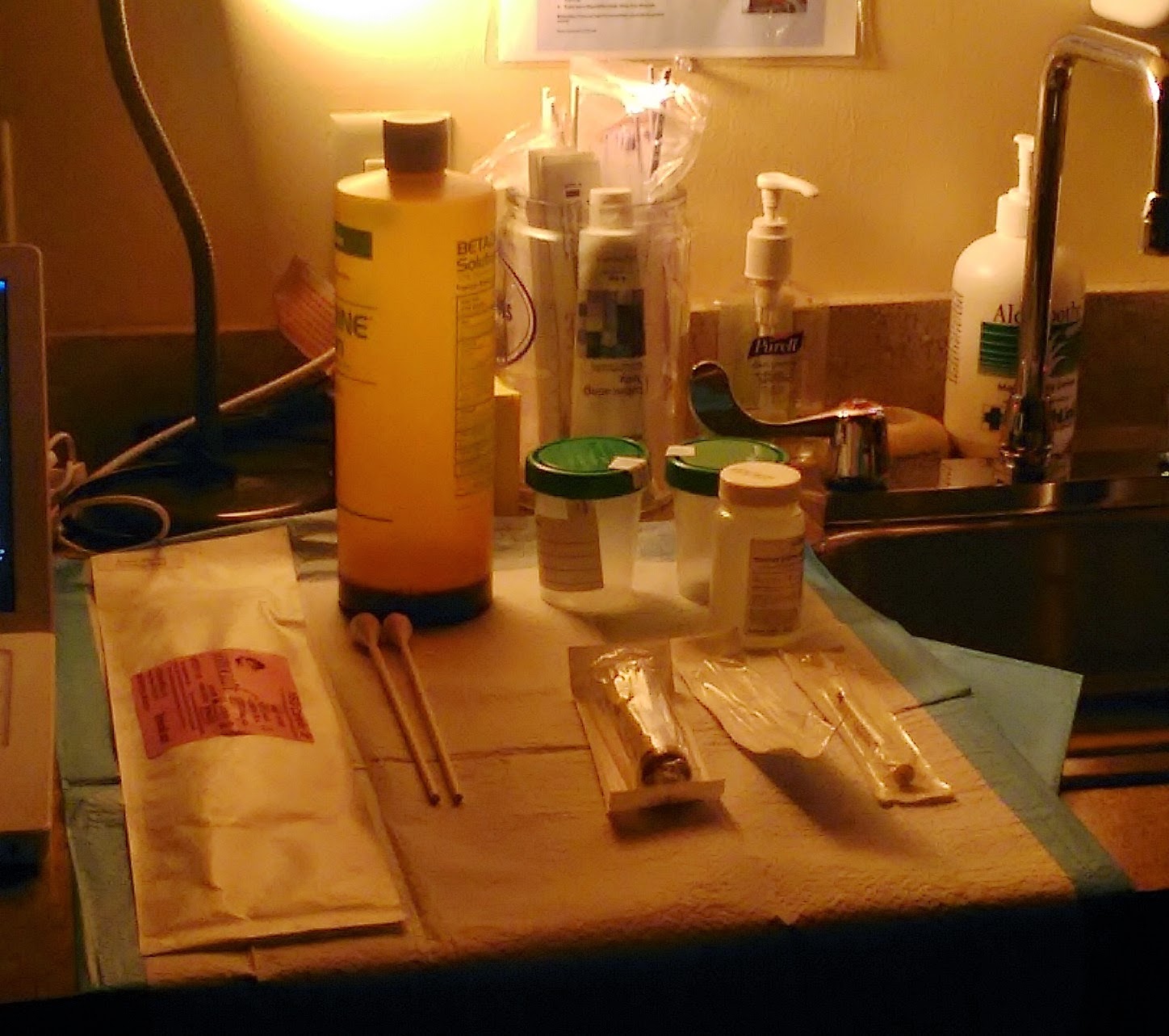
Generally not a fan of seeing all the equipment laid out...maybe that's just me.
Every doctor / clinic will do things a little differently, but there are many tests and procedures commonly performed in the fertility community.  The other day I had the misfortune opportunity to experience two I hadn't been through before: a mock transfer and a saline sono.

The mock transfer was performed first  I was instructed to drink 32 oz of water one hour before my appointment to ensure a full bladder (insert panicked "are you serious" face here, because that's what I made when I got these instructions).  It seems for this test they use a long catheter through the cervix as if they were placing an embryo guided by an abdominal ultrasound, and they need your bladder to be full so they can distinguish it from your uterus.  Not being a fan of any test that involves a speculum, my primary concern was how I could relax one set of sphincters to allow the speculum while keeping another set engaged to prevent a urinary blowout on the table.  I promised you an honest recount and a brutally honest one you shall have, people.  This was the test I dreaded more, and to be honest it wasn't nearly as bad as I had anticipated.  Perhaps the suggestion I read online was true, that focusing on not peeing during the procedure helped distract me from the activities themselves.  I'm not looking a gift horse in the mouth, especially since this was a test-run for a real transfer so I will obviously have to go through this again.  I do have a theory, though, that this test is really to see if you're prepared for all the bladder pressure you'd face during pregnancy because holding a full bladder while having things inserted vaginally AND someone applying external pressure with an ultrasound wand was a bit tricky.

Then came the saline sono.
Say hello to the transvaginal ultrasound.  While the tests I'm describing might be more relevant for more advanced ART (assisted reproductive therapies), the transvaginal ultrasound is pretty common right from the first few infertility tests.  You get used to it quickly.  And yes, they use condoms as sheaths - hey, why reinvent the wheel, right?
For this test, after getting to relieve myself (THANK GOD), I re-positioned on the exam table and they brought back everyone's favorite gynecological tool, the speculum.  After inserting a different catheter with a balloon attached to the end, the speculum was removed so that saline could be gently pumped into my uterus, expanding it for a better view.  They then used a transvaginal ultrasound (because, as the NP commented, there clearly isn't enough stuff going on in that region) to view the uterus and look for any physical / structural issues.  To keep the catheter in place and as a frame of reference, they inflate the little balloon at the end...and ladies (I assume most gentlemen have passed out by now) that is when the pain hit.  It was a very specific spot, I could point with my finger to exactly where it hurt, and it felt vaguely like someone driving an ice pick through my abdomen several inches south of my belly button.  This will vary a lot person-to-person but for me this was clearly the worst part of the visit.  My husband was present with me and poor boy almost lost his hand for me squeezing so hard.  You can watch the ultrasound images as the test is being performed and they'll happily describe what you're seeing.  This is usually something I do and definitely something I recommend - not only do you become more educated about your health, body, and treatment but it's also distracting - but this time I couldn't even open my eyes long enough.  Apparently they did see a small "blip", a white mark, which could be a small adhesion, a piece of tissue that just wasn't flushed out after my last period, or most likely, a small polyp.  Most women get these from time to time, and it's easy enough to deal with, but we needed the doctor to review the pictures and weigh in.  After the exam was over and they had all the images they needed, they removed everything and cautioned me that I would feel some of the saline drain out - yet another glamorous moment in my muck toward motherhood.

To be fair, I should qualify my description of the experience a bit: I did not scream or cry, and I wouldn't even describe this as the most painful experience of my life.  Also, once the procedure was over the pain subsided fairly quickly (yes I had taken ibuprofen prior to the appointment as suggested and yes, I took a little more afterward).  My biggest issue was that I had quite a bit of adrenaline flowing through my system between the pain and my anxiety about the whole visit, and I started shaking.  The NP and the medical assistant were cool about everything, they had me stay lying down for a bit after we finished, took my blood pressure, and got me some water.  It took a couple minutes but eventually the shaking subsided.  That's when the MA commented that my color was returning and after she stepped out again my husband informed me I had blanched to an unnatural shade of Clorox white even for my usual pasty-assed self.  While sitting up now sipping water, I asked when exactly I went so pale and he answered, "when they inflated the balloon".  I guess that struck me as funny because I laughed...and when my abdominals contracted it forced out some of the remaining saline.  Before I could stop myself I turned to him and blurted "YOU MADE ME SQUIRT"!  I must say, I hadn't seen him laugh that hard all day.

And that was my evening of IVF work-up tests.  I told you - shocking, funny, and more than a little ridiculous!

Friday, May 15, 2015

There's How Many Ways to Do This?

Image of ICSI found here.
Let's take a poll, shall we?

Raise your hand if you know someone who has struggled with infertility.

(If you actually have your hand up, good - it helps when you play along:))

Keep your hand up if you know someone who went through infertility treatments of any kind.

How about anyone who's been through IVF?

(I'm guessing a few hands have gone down but several are still up...let's keep going.)

Keep your hand in the air if that person you know who did IVF had a baby from the treatment.

(You're such good sports!  You can put your hands down.)

If I were the betting type, I'd have money on the chance that almost every hand that was up for "I know someone who did IVF" was still up for "they had a baby".  Is that because IVF always works?  HELL no. In fact, most women who go through IVF have only a 20-35% chance of success in a given cycle - anything over 40% is considered terrific. No, it's because in our society, we don't talk about IVF that doesn't work, let alone the things involved in the IVF process.  Unless the person doing IVF was you, a sibling, or your absolutely closest friend, I'd be surprised if you even know they were doing it until the baby was at least visibly on his or her way.  I'd bet you have no idea how many rounds that couple may have failed before having a successful transfer and pregnancy.  It's likely not your fault, they just didn't feel comfortable telling everyone.  But we all know I am not encumbered by such social norms :D

I am just beginning my journey through IVFland.  This week marks two years my husband and I have been TTC (trying to conceive), and we've been through quite a bit of testing, medications, surgery, and several different types of treatments.  We've done the classic Clomid, tried IUI.  We did, one time, get pregnant but as you know the baby had a trisomy (third copy of a chromosome) and resulted in a miscarriage right before Christmas.  We finally took a step back after that to consider if we wanted to continue treatments, and explored the adoption scenario.  After checking out three agencies, we determined that adoption may be in our future but right now we are better prepared to try some more treatments.

However, we also decided we were not satisfied with the fertility specialist we had been seeing and realized it was time for a second opinion and a new approach.  Fortunately, through the infertility support group I joined, we were aware of a few local alternatives and one in particular which seemed to have a very passionate following, and who offered a free 2nd opinion consultation option!  We took our records from the three previous doctors, went through our entire medical histories, discussed our concerns, and sat down with the new doctor.  I'll dedicate another post to why I'm liking this new place so much, but suffice it to say she has the approach we need not only to treatment but also to patient care.  Her advice is try a "mini-stimulation" cycle of IVF which uses a significantly lower quantity of medications than traditional IVF, as my tests indicate I'm likely to be a good responder.  This is important to us with all my medical issues, as we are concerned about what the process could do to my body and overall health.

And so here we are, going through the steps to get ready for our first IVF cycle.  Oh, and by the way, the terms "IVF cycle" itself is confusing, so let's break it down:
  1. The first phase of IVF is egg retrieval.  This is where they stimulate the woman's ovaries to produce a higher number of eggs than are usually developed during a natural ovulation cycle.  When ultrasounds and blood tests show the follicles are mature, a needle is inserted through the wall of the vagina (while under anesthesia) to draw out the liquid in each follicle which should contain the eggs.  
  2. The eggs are then fertilized (this can be with the male partner's sperm or donor sperm, and the sample may be provided the same day or in advance and frozen).  This can be done old school with many sperm in a petri dish or via ICSI (Intra-Cytoplasmic Sperm Injection) where one sperm is selected and injected into the egg.  My clinic performs ICSI.
  3. The fertilized eggs are then incubated for a period of 3 - 7 days (this depends on your doctor, personal preferences, specific medical scenarios, etc).  With my clinic they usually grow for 5 days.  It is important to note that it's unlikely all embryos will make it the full length of time.
  4. At this point one of two things will happen.  You can have a fresh transfer which involves placing an embryo in your uterus with a catheter on that 5 day mark (my clinic will only transfer one at a time, and I'm ok with that - with all my medical issues we don't need the added risks of carrying twins).  This will depend on how retrieval went along with your health at the time.  There are several things that could preclude a fresh transfer, including your own preferences.
  5. If you don't have a fresh transfer, all embryos will be frozen.  If you do a fresh transfer, any remaining embryos will be frozen.  Oh, and you have another decision to make - PGS.
  6. PGS is Preimplantation Genetic Screening, which is a NON-DESTRUCTIVE test that can be performed on embryos (and which even the best insurances don't cover).  Prior to freezing, a small biopsy is taken from the outer ring of cells which will eventually form the placenta (thereby leaving the cells that become the baby itself untouched).  The sample is then examined to determine if the embryo is chromosomally normal.  The test will determine if the embryo has the right number of chromosomes, which chromosomes may be missing, and which may have an extra copy.  It will also identify the sex of the embryo but you can ask your doctor not to tell you that.  So yes, this test will tell you if your baby has Down Syndrome or another chromosomal condition - whether compatible with life or not.  It will NOT tell you traits such as eye color, genetic risk factors, and so on.  How you use this information is a personal choice.
  7. Once you have a fresh or frozen embryo transfer, you enter the infamous "Two Week Wait" where time seems to stand still and your stress level reaches new heights.  There's a lot of discussion around how to survive the time you wait to find out if the embryo implanted, and most tips center around how to keep your mind busy.  A lot of women stock pile books or binge-watch TV series.  Part of the challenge is that most forms of exercise (a stress-relief tool used by so many people) will be off limits during this time adding both to your physical discomfort and your anxiety.  During this time, it's common to continue a hormone protocol, depending on your specific case.
These are just the basic steps.  When someone says they are having an IVF cycle, it could mean that they're having a transfer, or a whole new egg retrieval being done.  And this process involves so many decisions and choices I never, ever contemplated before being in this boat.  What do I need / want to do to prepare my eggs for retrieval?  This could mean medication, supplements, acupuncture (which is incidentally something my peers SWEAR by), clean eating or other special diets, specific exercises, massage, even special heat compresses.  The medications you might take during stimulation, while preparing for a transfer, or following a transfer will mostly be directed by your doctor but you do have some input, again including diets, supplements (ALWAYS clear them with your doctor - "natural" doesn't mean it won't interact with meds), exercise (if permitted), and so on.  It's overwhelming.

So this is where I am.  I am preparing for my first egg retrieval which for me means going through several more tests since I am new to this clinic, and panicking because I'm well within the 90 day window prior to retrieval when studies indicate you can most impact the quality of your developing follicles and I have NO IDEA what if anything I should be doing differently.  Next week I will meet with my doctor again to review everything and hopefully get the green light for the retrieval, after which my husband and I will have to go for informational sessions and to be trained on administering the injections at home to encourage egg development.  I'm attending support groups twice a month (one led by a therapist and one peer-led group organized under the awesome national organization RESOLVE), and we are also in touch between meetings as we're all in a high-activity state right now.

So, if your'e still with me after all this discussion, I'll ask you one last question - how many of you had any idea what's involved in IVF?

Because I sure as hell didn't.